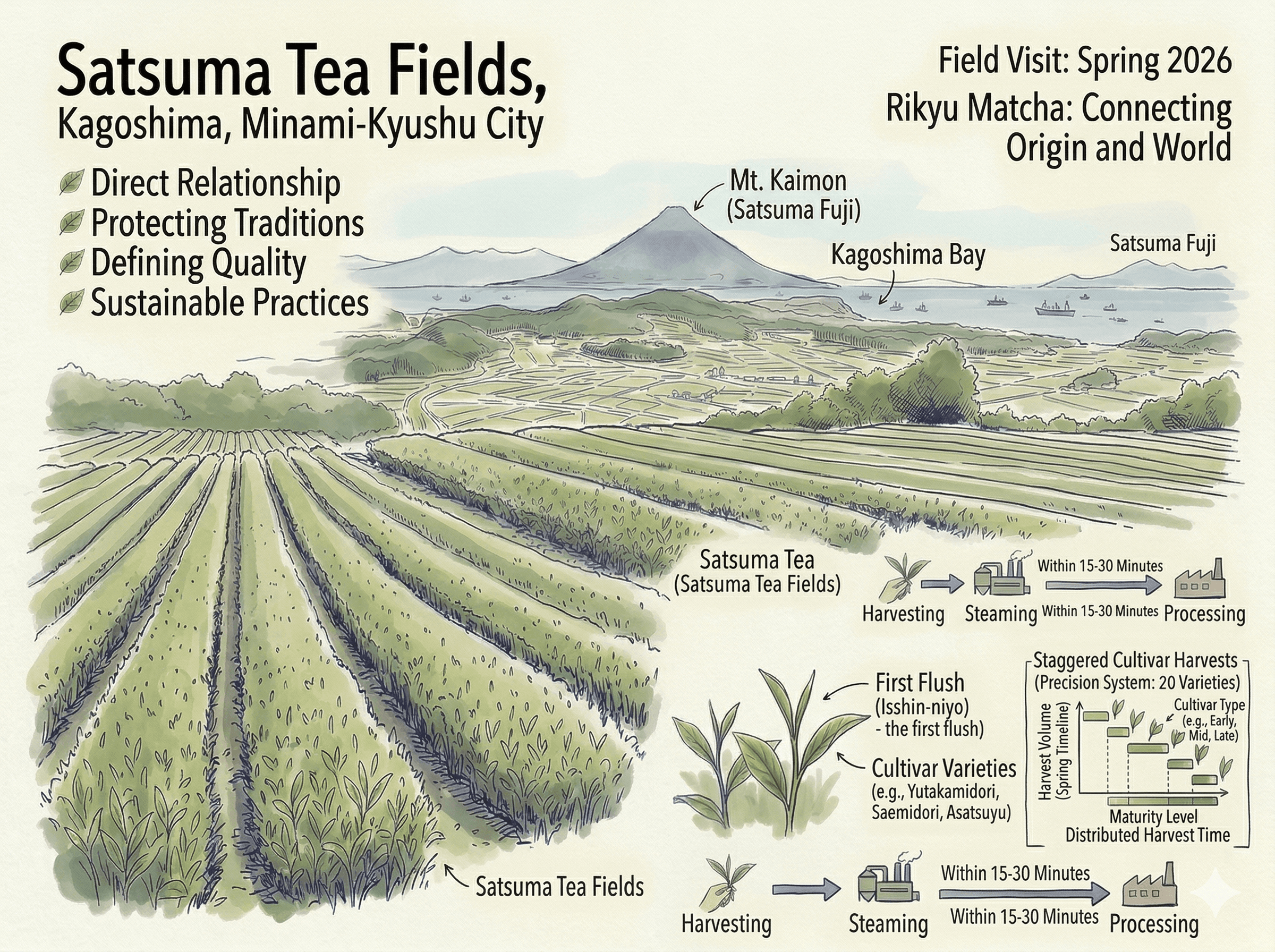
In Japan, spring doesn't arrive all at once. It moves — slowly, deliberately — from south to north. And so does matcha harvest season.
Kagoshima, Japan's southernmost major tea-growing region, is always first. While the rest of the country is still waiting for warmer days, the tea fields of Satsuma are already alive with the year's first flush of new growth. Our team at Rikyu Matcha recently made the journey down to witness it firsthand.
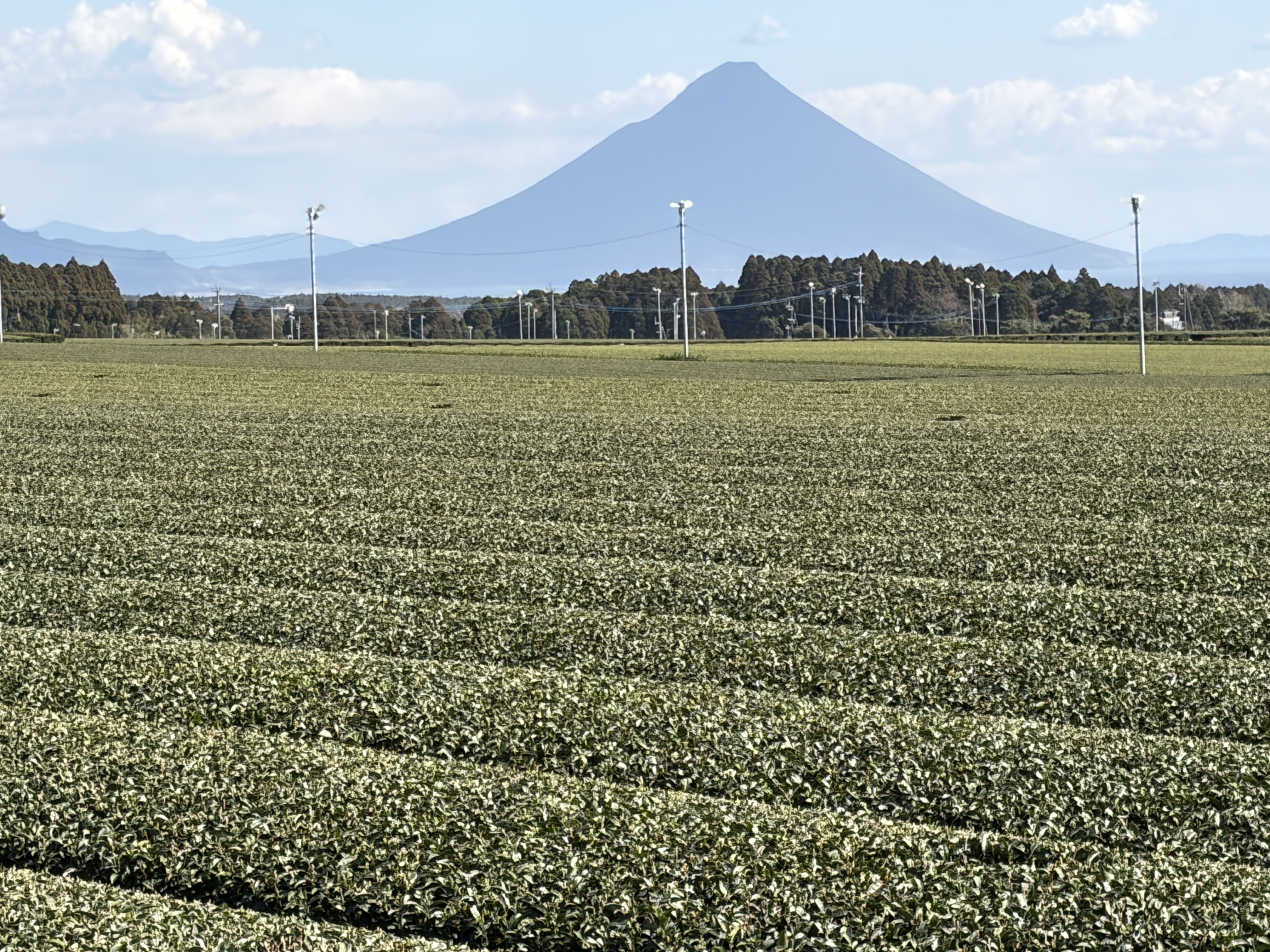
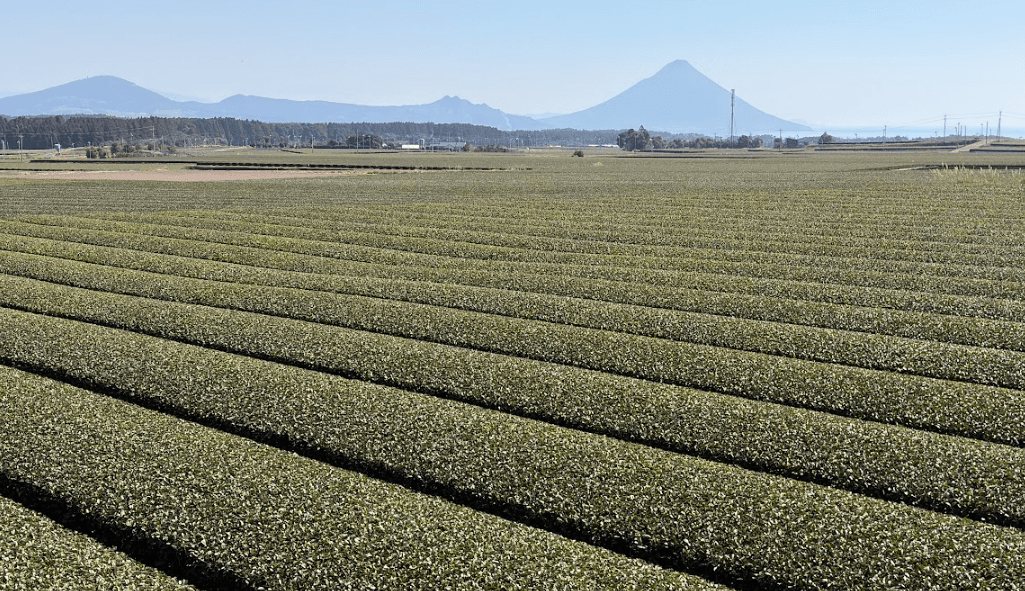
A view of the tea plantations with Mount Kaimon in the background.
Built on Direct Relationships, Across Every Major Region
One of the defining features of Rikyu Matcha is that we have producer partners in every major tea-growing region in Japan — from Uji and Nishio to Kagoshima. And in every case, those relationships are direct.
We don't buy through brokers. We visit the farms. We sit with the producers, walk the fields, and ask the questions that matter: What drives your decisions? What are you protecting? What does quality mean to you?
This approach means that when we talk about the matcha we source, we're not reciting spec sheets. We're sharing the philosophy of the people who grew it. That's what we bring to our partners around the world — not just a product, but a story grounded in real knowledge and real trust.
Why Kagoshima Goes First
Japan's matcha harvest begins as early as April in Kagoshima, making it the first region in the country to yield new leaves each year. From there, harvest progresses northward over the following months, region by region.
When we arrived in Satsuma, Minami-Kyushu City, the fields were already preparing for the season ahead. But what struck us most wasn't the landscape — it was the level of intentionality behind everything we saw.
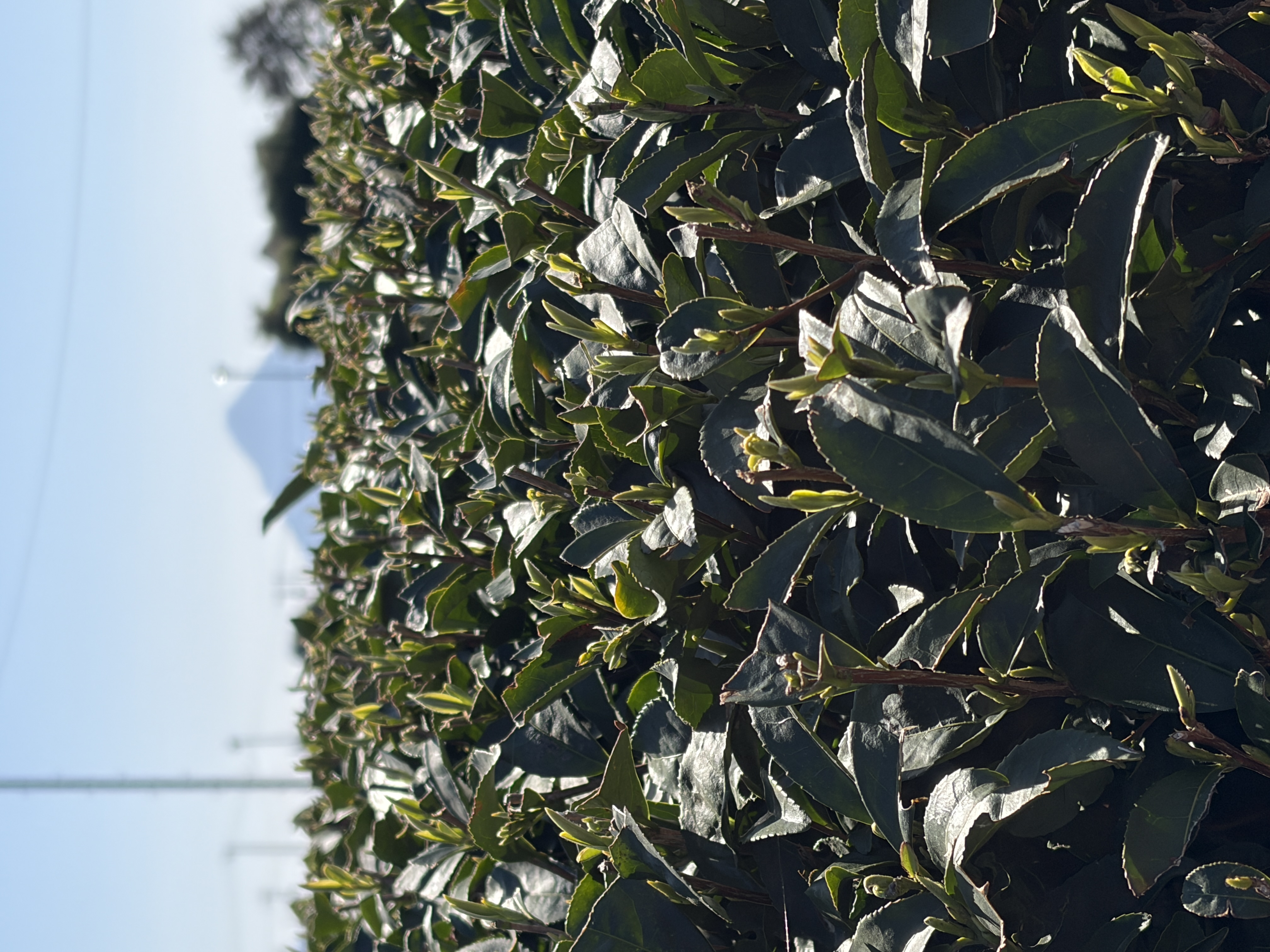
Fresh tea buds are sprouting; these small, yellowish-green shoots will eventually grow and be processed into matcha.
Twenty Varieties, One Precision System
Timing is everything in matcha production. Leave the new shoots on the plant too long, and the leaves toughen. Tougher leaves mean a compromised flavor profile — less of the bright umami and vibrant green that define premium matcha.
To manage this, our producer partner in Satsuma has developed a remarkably deliberate approach: over 20 different cultivars are planted across the farm, each selected for its distinct growth rate. By staggering varieties that mature at different speeds, the harvest window is carefully distributed across weeks rather than compressed into a single overwhelming rush.
This isn't just a practical workaround — it's a form of agricultural craftsmanship. The farm functions like a finely tuned schedule, with one variety reaching peak readiness just as another finishes. It's the kind of system that only emerges from decades of observation, iteration, and deep respect for the plant.
From Field to Steam: Within 15 to 30 Minutes
Once tea leaves are picked, the clock starts immediately. Oxidation begins the moment a leaf is separated from the plant, and it's the first processing step — steaming — that halts that process and locks in color, aroma, and nutritional value.
At this farm, that window is kept to 15 to 30 minutes from harvest to steam. Every time.
This is made possible by two things working in tandem: the physical proximity of the fields to the processing facility, and a harvest schedule that's synchronized precisely with the factory's capacity. There's no waiting. No backlog. The leaves move from the field to the steamer while they're still at their best.
Standing in that facility, watching the process unfold in real time, it became clear why this commitment matters. The first 30 minutes of a tea leaf's journey after harvest shapes everything that follows — every cup, every shot of espresso, every matcha latte served thousands of miles away.
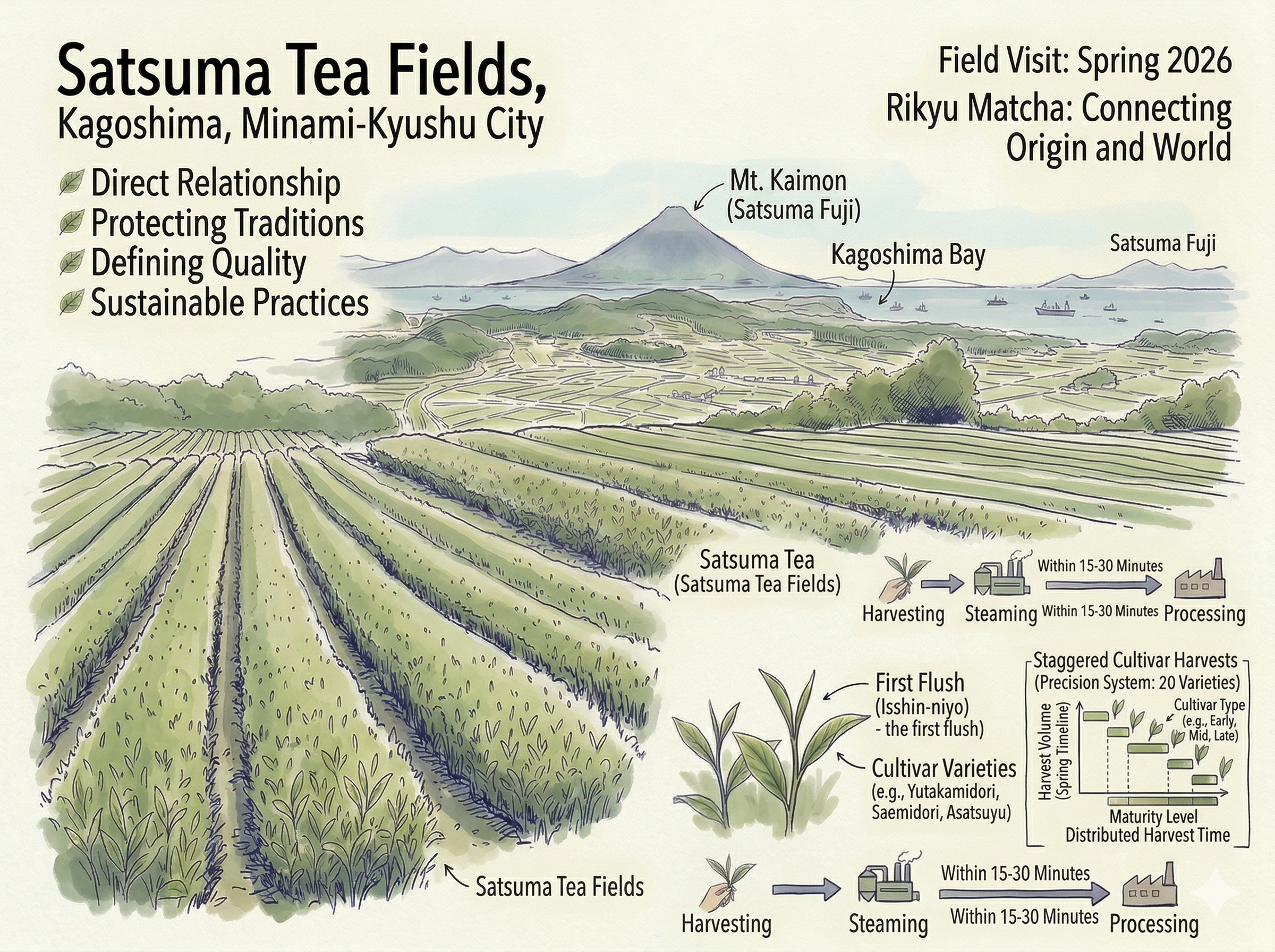
This Is What Sets Rikyu Matcha Apart
There is no shortage of matcha brokers and dealers in the global market. But there's a meaningful difference between sourcing matcha and understanding it — between moving product and representing the people who produced it.
At Rikyu Matcha, we exist to be a direct bridge between Japanese producers and the global businesses and enthusiasts who want to serve something genuinely exceptional. The fields of Satsuma, the precision of the harvest design, the steam rising from the factory floor — all of it travels with every order we send out.
That's not a marketing claim. It's the result of showing up, year after year, and building relationships that go deeper than a transaction.
Bring This Quality to Your Business
Whether you run a specialty café, a restaurant, a food brand, or a retail concept — if you're looking for matcha that comes with real provenance and real producer knowledge behind it, we'd love to talk.
📩 Email us: rikyu@teamfriend.co.jp
Written by Mizuki Yasuda, CEO of Rikyu Matcha Field visit: Satsuma, Minami-Kyushu City, Kagoshima, Japan — Spring 2026